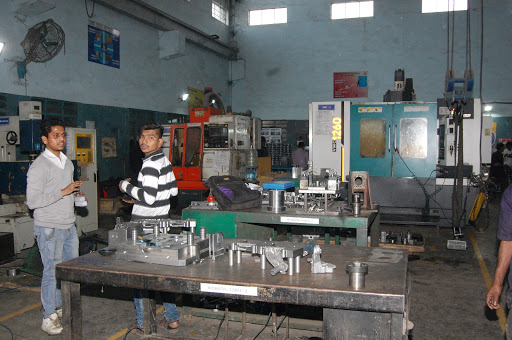
Pressure Die Casting Tool Manufacturing
What Is Pressure Die Casting Tool Manufacturing?
Pressure die casting tool manufacturing entails designing, machining, and assembling
precision moulds used for the casting of high-quality metal pieces under very high pressure. These tools are usually
manufactured from heat-resistant steel alloys and are needed to generate highly detailed aluminium,
magnesium, or zinc parts with outstanding dimensional tolerances and surface finish.
We at Advance Technologies are committed to providing pressure die casting tool manufacturing
services to industry standards that will cater to your needs. With the strength of our research
capabilities in design, CNC machining, and quality control, we assure that every tool we supply is backed
by a stable, smooth, fast, and cost-efficient casting operation.
Our tools find applications in various fields like automotive, aerospace, electrical, power engineering,
and heavy engineering, where an edge cannot be given to precision and reliability.
Major Steps in Pressure Die Casting Tool Manufacturing
The depiction of the pressure die casting tool manufacturing process suggests that it
is a technical,
difficult, and yet interesting process demanding significant engineering precision in every step. Below is
a quick snapshot of the main phases of this process:
Design and Simulation: The first step involves detailed 3-D-CAD design and mould-flow
simulation to ensure proper metal flow, cooling, and ejection performance.
Material Selection: Materials of the highest quality, hot-work steel, are chosen: mainly H13 or
SKD61. These materials endure heavy heat and repeated pressure cycles.
CNC Machining and EDM: Mould geometry and cavities are produced in exact detail by high- speed CNC machining and EDM.
Heat Treatment and Finishing: The tools are heat-treated to give them hardness, and heat
treatment also imparts great strength to the tools. It is followed by finishing and polishing to
impart a smooth finish to the casting surfaces.
Assembly and Testing: The final process is assembly of tool components, alignment of ejector
pins and trial testing of die function to ensure smooth casting operation.
At Advance Technologies, each level within pressure die casting tool manufacturing is scrutinised to
ensure uniformity, longevity, and efficiency.
How High-Pressure Die Casting Is Used to Manufacture Heavy Vehicle Engine
Components
By using a high-pressure process, the automotive industry widely applies it to produce
lightweight and
durable engine blocks, gearbox housings, and cylinder heads. The method comprises molten aluminium
being injected at high speed and pressure into the die cavity, usually between 1,500 and 25,000 psi.
That's what makes it suitable for heavy vehicle engine components:
Dimensional Accuracy - High-pressure injection assures tight tolerances along with complex
geometries without the need for secondary machining.
Strength and Durability - Liquiform under pressure guarantees strength, and rapid solidification improves the grain structure of the components.
Surface Finish - Components emerge with a smooth surface and require very little additional finishing.
Lightness - Aluminium components with a good strength-to-weight ratio contribute to enhanced vehicle performance and fuel efficiency.
The bottom line is that the precision of pressure die casting tool manufacturing juxtaposes the quality
and reliability of these automotive components.
Why Pressure Die Casting Is Cost-Effective and Reliable
Pressure die casting tool manufacturing is in the limelight to make the casting
process affordable and reliable. Here is how:
High Production Efficiency: After the die has been created, thousands of parts can be produced
in mere minutes under the control of human interaction.
Reduced Waste: This method advocates near-net shape production with hardly any waste of material.
Consistency: Castings made from the same die are identical in dimensions and quality.
Low Maintenance: With effective design and heat treatment, the dies are kept in working
condition for a long time, thus reducing monetary losses on replacement.
Integration with Automation: Modern die casting system integration with robotic handling and
trimming is also possible, thus enhancing operational efficiency.
Pressure die casting tool manufacturing services at Advance Technologies offer a synthesis of
productivity with an uncompromised level of accuracy and quality.
Conclusion
There are two types of pressure die casting - High Pressure Die Casting and
Low-Pressure Die Casting - depending on the pressure used. While Pressure Die Casting Tool
Manufacturing in Pune provides a wider application that encompasses almost 50 percent of all
casting production of light alloy. Low-pressure die casting currently accounts for around 20 percent of
total production but its use is growing. For castings that require a tight tolerance and detailed
geometry, high-pressure castings are required. In larger and non-critical sections low pressure dies
casting is widely used.